Flowing at 868 MHz, an end-to-end encrypted network.
OSOS's network architecture is not an outsourced component — from device firmware to gateway communication, and from the network server to platform integration, it is OSOS's own engineering. Every packet on its way from the meter to the AI is verifiable and encrypted at every step.
From meter to AI, five layers.
Every reading packet travels this path. The first hop is wireless (RF); every step after that is a TLS-encrypted backend connection.
One gateway, an entire city.
This is where LoRaWAN's power comes from: a single gateway, at low power, covers a wide area on its own, cutting through buildings and city noise — the site is reached with a single communication point, not dozens.
An energy/latency trade-off that adapts to the site.
OSOS modules can operate in two different LoRaWAN device classes, depending on the site's needs.
Preserves battery life for years.
Data transmission is bidirectional but happens on fixed periods. Two short receive windows open after each uplink, then the device returns to sleep mode. Preferred on sites that want to maximize battery life.
Enables instant intervention.
The device stays in continuous listening mode even when it is not transmitting data. This gives the system on-demand reading and instant remote intervention capability — for example, a valve command in seconds via I‑METS 80.
A separate verification at every layer.
We don't rely on a single security measure — five independent layers, from network join to key generation.
- 01
AES‑128
End-to-end encryption — the data packet is encrypted at every step, from the device to the platform.
- 02
OTAA
Over‑The‑Air Activation — the device is re-authenticated on every network join; no static key is ever fixed.
- 03
TLS 1.2+ / mTLS
Every backend connection, from the gateway to the network server and the platform, is encrypted with TLS.
- 04
Frame Counter
Every packet is counted; replay attacks are blocked by the frame counter check.
- 05
HSM
Key generation happens inside a hardware security module (HSM); keys never surface to the software layer.
Not a claim — a measured signal.
The image below is live connection-quality data for a real device from the OSOS Platform — RSSI, SNR, and the gateway it is connected to.
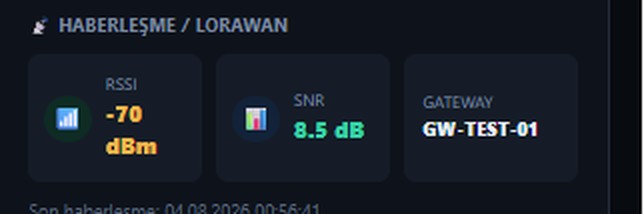
Communication / LoRaWAN Panel
Every device's signal strength (RSSI), signal-to-noise ratio (SNR) and connected gateway ID are monitored in real time on the platform.
RSSI and SNR values let us verify the connection quality of every device on the site individually. A device with a weak signal is automatically flagged on the platform before the field team steps in.
The network architecture is certified to industry-standard compliance.
Review the network architecture's technical documentation.
Request the technical documentation covering the frequency plan, security layers and integration details. Beyond the standard I‑METS product family, we also design and deploy fully custom, end-to-end LoRaWAN projects tailored to your site's specific requirements.